

Origen 35 — Santa María Tlalixtac, Oaxaca
Mexico's most unexpected whiskey.
Distilled from purple bolita heirloom corn by Isidoro Krassel Peralta. A tribute to Oaxaca's 35 native corn species — proof that Mexico's distillation heritage reaches far beyond agave.
About the Name
35 varieties of corn. One whiskey.
Oaxaca is home to more than 35 native corn species. Origen 35 is a tribute to every variety cultivated in these mountains for thousands of years.
The whiskey is made from purple bolita — a small, dense, deeply pigmented heirloom corn grown in Oaxaca for centuries. In the hands of Isidoro Krassel Peralta, it becomes an artisan whiskey with terroir.
Native corn species
in Oaxaca — among the most biodiverse maize regions on earth
Generation
Isidoro Krassel Peralta represents a century of family distillation in Santa María Tlalixtac
Charcoal filtration
for 48 hours before bottling — the final refinement step after column distillation
Plate column still
custom-fabricated by the Krassel brothers — the same still used for every production run
Origin Story
The Krassel family, third generation.
The Krassel family has distilled in Santa María Tlalixtac, Oaxaca for over a century. Max Krassel founded the tradition in the 1930s. Isidoro Krassel Peralta, third generation, applied the family craft to something new: an Oaxacan corn whiskey.
Isidoro saw the logic: Oaxaca has been cultivating corn for thousands of years. Purple bolita heirloom corn has been part of Oaxacan culture since before written records. Why not as a distillation grain?
Isidoro and his brothers designed a 12-plate column still themselves and developed an 8-step production process that treats corn with the same intention a maestro mezcalero gives to agave. Imported by Bad Hombre Importing and distributed in California by Cultura Maguey.
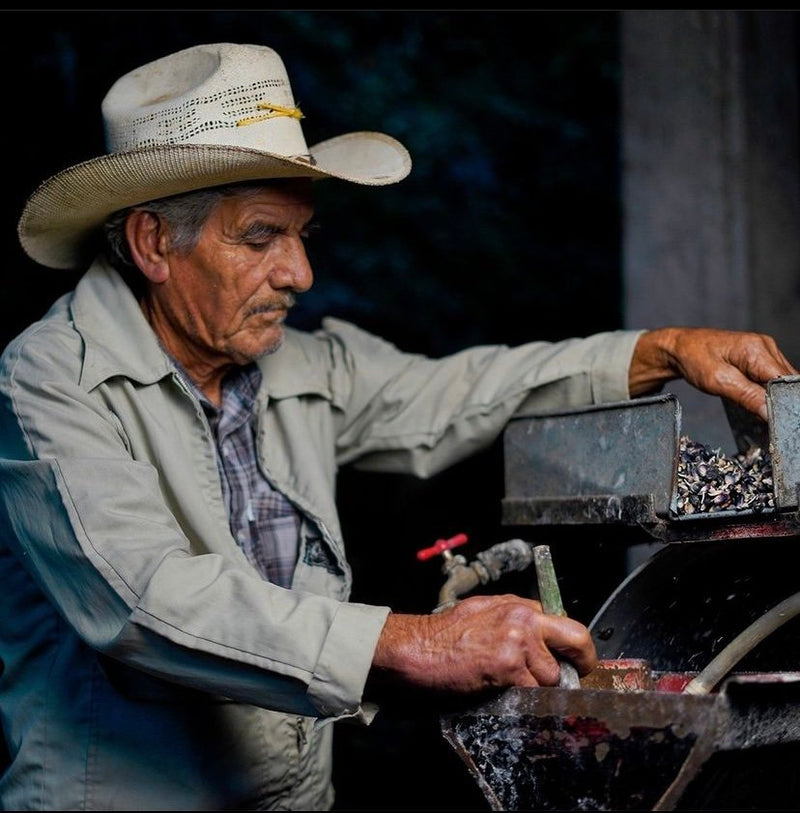
Eight-Step Production
Every step earned.
Origen 35 follows an 8-step production process developed by Isidoro Krassel Peralta to honor the grain the way a maestro mezcalero honors agave.
Corn Selection
Purple bolita heirloom corn — one of Oaxaca's 35 native varieties — grown by local farmers using traditional milpa methods.
Hand Malting
Hand-malted on woven palm petates (mats) for 10–15 days. Natural germination converts starches to fermentable sugars.
Comal Toasting
Kiln-dried on a traditional clay comal over wood fire. Halts germination and develops toasted grain character unique to Oaxacan production.
Nixtamal Milling
Milled through a traditional nixtamal stone mill — the same equipment used for tortilla masa.
Mashing
Milled grain cooked with local water at controlled temperatures to gelatinize starch and maximize sugar extraction.
Wild Fermentation
Wild ambient yeasts native to the palenque. No commercial yeasts. 5–8 days fermentation.
12-Plate Column Still
Custom 12-plate column still fabricated by the Krassel brothers. Clean, grain-forward with bolita corn character retained.
Charcoal Filtration
Filtered through activated charcoal for 48 hours before bottling. Refines texture without stripping flavor.
Why It Matters
Mexican whiskey is real — and it starts in Oaxaca.
The Mexican Whiskey Category
Mexico has been distilling corn since long before Scotland distilled barley. The Whiskey Oaxaqueño category is nascent but serious — a natural extension of a culture that has always understood how to coax complexity from grain. Origen 35 is one of the most credible examples in the world, and one of the very few available in the United States.
California Availability
Origen 35 is imported by Bad Hombre Importing and distributed by Cultura Maguey across California and the West Coast. It reaches bars and bottle shops that want something genuinely different — not a novelty, but a serious craft spirit with a documented story, a living distiller, and a grain with 10,000 years of history behind it.
Heirloom Corn & Terroir
Purple bolita corn is a cultivar unique to Oaxaca. Small, dense, and deeply pigmented, it grows at altitude in the same milpa systems that have supported Oaxacan communities for millennia. Using it as a distillation grain is an act of cultural preservation as much as it is a production decision — and it gives Origen 35 a terroir that no imported grain can replicate.
Frequently Asked Questions
Everything you want to know.
What makes Origen 35 a whiskey and not a mezcal?
Origen 35 is made from corn, not agave. It is classified as Whiskey Oaxaqueño — a grain spirit using the same craft values as mezcal but a distinct category.
Where can I buy Origen 35 in California?
Available through Cultura Maguey's online bottle shop with California delivery and at select specialty retailers on the West Coast. Importer: Bad Hombre Importing LLC.
What is purple bolita corn?
A small, dense, deeply pigmented heirloom corn native to Oaxaca — one of 35 indigenous varieties. Grown for thousands of years using traditional milpa systems.
Who is Isidoro Krassel Peralta?
Third-generation distiller in Santa María Tlalixtac, Oaxaca. His grandfather Max Krassel founded the family distillery in the 1930s. Isidoro and his brothers designed and built the 12-plate column still.
Is Origen 35 aged or unaged?
Unaged — a blanco expression. Charcoal filtered for 48 hours. No aging, no coloring, no additives.
Available in California
Mexico's most unexpected whiskey.
Origen 35 is available through Cultura Maguey's bottle shop and at select retailers across California and the West Coast.
Shop Origen 35 →
Agua Del Sol — Oaxaca, Mexico
The water of the sun.
A co-op of Oaxacan maestros. Micro-batches of destilado de agave with every producer on the label. No certification required — only craft, community, and truth.
Origin Story
A co-op built on trust, not contracts.
Felix Hernández Monterrosa and Adriana Correa founded Agua Del Sol out of Mezcaleria CUISH in Oaxaca City. Rather than building a single distillery, they built something more honest: a network of maestros and maestras across the Central Valleys, each producing small batches using methods handed down through generations.
Every bottle features a photograph of the producer who made it. The name, village, agave species, and production method appear on the back label — because that information belongs to the person who created the spirit.
Bottled as a destilado de agave — a practical and principled choice keeping costs accessible and giving producers freedom to work without regulatory interference. Imported by Bad Hombre Importing and distributed in California by Cultura Maguey.
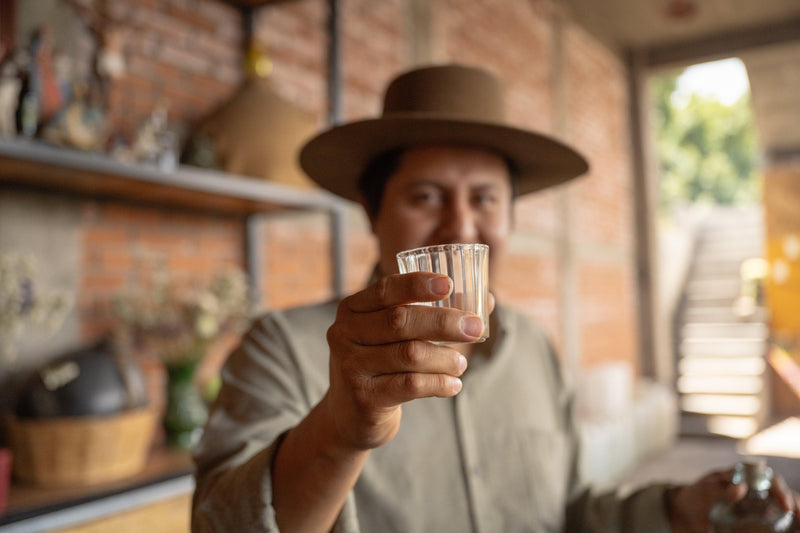
Traditional Production
Six steps. No shortcuts.
Every expression in the Agua Del Sol lineup follows the same time-tested process — the same methods used in the Central Valleys for generations.
Harvest
Mature agave plants — typically 8 to 15 years old — are harvested by hand. The piñas are trimmed and transported to the palenque.
Steam Cook
Piñas are cooked in stone-lined earthen ovens — not underground pit roasted. This steaming method caramelizes agave starches and develops cooked-agave sweetness with a more restrained smoke character.
Tahona Mill
Roasted piñas are crushed under a large stone tahona wheel pulled by horse or mule, extracting juice and fibers together.
Fermentation
The crushed mash is fermented in open-air cypress wood or animal hide vats using only wild ambient yeasts. Fermentation takes 5–10 days.
Double Distillation
Distilled twice in small copper pot stills or clay pots (olla de barro). The maestro controls cuts by taste and feel — no instruments.
Bottling
Bottled at natural proof without additives. Each batch receives a back label with producer photo, name, village, agave species, and production date.
Current Expressions
Every maestro. Every agave. Every village.
Expressions rotate as batches sell out and new harvests are completed. Each release is a unique moment in time — a specific producer, harvest, and place.
Oaxaca — Santiago Matatlán · Valles Centrales
Espadín
Agave angustifolia Haw.
Signature expression by the Monterrosa Family. Steamed stone-lined oven, horse-drawn tahona, Cypress vats, copper alembic. Clean, structured, honest. 1-liter format.
Maestro: Monterrosa Family · 48–49% ABV
Oaxaca — San Carlos Yautepec · La Chontal
Pelón Verde
Agave angustifolia Haw. — Pelón Verde variety
A rare regional variety of A. angustifolia from La Chontal. Mtra. Reyna Rodriguez. 164 bottles, April 2024. Steamed oven, tahona, Cypress vats, copper alembic.
Mtra. Reyna Rodriguez · 46.5% ABV · 164 bottles
Oaxaca — San Baltazar Chichicapam · Valles Centrales
Madrecuishe
Agave karwinskii — Madrecuishe variety
Columnar A. karwinskii. Mtra. Berta Vásquez. 132 bottles, June 2024. Steamed oven, tahona, Cypress vats, copper alembic.
Mtra. Berta Vásquez · 48% ABV · 132 bottles
Oaxaca — San Guillermo Miahuatlán · Miahuateco · ~5,200 ft
Coyote
Agave Lyobaa (Coyote variety)
High-altitude Miahuateco. Mtro. Raúl García Santana. 198 bottles, Spring 2023. Stone-lined oven + encino wood, wood chipper and bull-drawn tahona, copper alembic with refrescadera.
Mtro. Raúl García Santana · 48% ABV · 198 bottles
Oaxaca — San Baltazar Chichicapam · Valles Centrales
Espadín con Maíz y Cacao
Agave angustifolia Haw. — co-distilled with toasted maíz and cacao
Pechuga-style: 2nd distillation with 5 kg toasted maíz and 6 kg toasted cacao. Mtra. Berta Vásquez. 198 bottles, Summer 2025. Layered and savory.
Mtra. Berta Vásquez · 47.1% ABV · 198 bottles
Oaxaca — Miahuatlán · Limited Artist Collaboration
Mujer del Istmo
Agave potatorum — 100% Tobalá
Limited artist collaboration with LA Chicano artist Eric Mancha. Honors Zapotec women of Tehuantepec. Maestros Francisco and Raúl García. Crafted at the intersection of Oaxacan tradition and Chicano identity.
Maestros Francisco and Raúl García · Limited Release
Why It Matters in California
The West Coast deserves the real thing.
Destilado de Agave vs. Mezcal
The destilado de agave category exists outside the COMERCAM certification system — which means producers pay no certification fees and face no production-method restrictions. For co-op producers with small batches, it is the most honest category available. The spirit is identical in technique to certified mezcal; only the paperwork differs.
California Distribution
Agua Del Sol is imported by Bad Hombre Importing and distributed exclusively in California and the West Coast by Cultura Maguey. Available at our online bottle shop and at select restaurants, bars, and specialty retailers. If your favorite bar or bottle shop does not carry it — ask them to.
Producer Transparency
Every bottle names and photographs the producer. This is radical transparency in a category where provenance is routinely obscured. When you buy Agua Del Sol, you know exactly who made it, where they live, what agave they used, and how they made it. That information has value — and we protect it.
Frequently Asked Questions
Everything you want to know.
What is a destilado de agave and how is it different from mezcal?
A destilado de agave is produced outside the mezcal Denomination of Origin. Production methods are often identical but producers operate outside the regulated zone or decline certification. Small co-op producers use this category to avoid fees and retain production freedom.
Where can I buy Agua Del Sol in California?
Agua Del Sol is available through Cultura Maguey's online bottle shop with California delivery and at select specialty retailers on the West Coast. Importer of record: Bad Hombre Importing LLC.
Who makes Agua Del Sol?
Founded by Felix Hernández Monterrosa and Adriana Correa of Mezcaleria CUISH in Oaxaca City. Sourced from a co-op network of independent maestros across the Central Valleys of Oaxaca.
What agave varieties does Agua Del Sol produce?
Rotating expressions include Espadín, Tobalá, Mexicano, Tobasiche, Bicuishe, and Ensamble co-distillations. Availability rotates by harvest.
Is Agua Del Sol organic or sustainably produced?
Producers work without synthetic inputs, commercial yeasts, additives, or accelerants. Not formally certified organic, but production reflects generations of sustainable land stewardship in Oaxaca.
Available in California
Taste the water of the sun.
Agua Del Sol is available through Cultura Maguey's bottle shop and at select retailers across California. Every purchase supports the producers, communities, and culture they represent.
Shop Agua Del Sol →